Our top products

  • Cloud HCM
  • Digital Visa Management
  • Employee Performance Management
  • Evaluation and Survey
  • Incentive Management
  • Recruitment Management
  • +971 4 556 1999
  • info@infinigent.com
  • Sat – Thu 8:00am – 6:00pm
Infinigent Infinigent
  • Home
  • Products
    • HCM & Payroll
      • Overview
      • Human Resource
      • Time & Attendance
      • Payroll
      • Employee Self-Service
      • Performance Management
      • Recruitment
    • Digital & Other Solutions
      • Digital Visa Management
      • Project Resource Management
      • Customer & Project Management
      • Evaluation and Survey
      • Incentive Management
  • Services
    • Software Services
    • IT Consulting Services
  • Company
    • About Us
    • FAQ
    • Privacy Policy
    • Terms of Use
  • Blog
  • Contact Us
AI-powered HR software dashboard with UAE skyline, illustrating AI automation, recruitment, employee insights, and compliance for UAE businesses in 2026.

Is AI in HR Software Actually Useful for UAE Businesses in 2026?

Table of Contents

  • What AI in HR Software Actually Means
  • Why This Matters More in the UAE Than Almost Anywhere Else
  • Where AI and Automation Genuinely Solve UAE HR Problems
  • How This Plays Out in Practice: Infinigent’s Approach
  • A Practical Checklist for Evaluating AI Claims from Any Vendor
  • Conclusion:
  • Frequently Asked Questions: 

Yes, AI in HR software is genuinely useful for UAE businesses in 2026, but only when applied to specific, measurable workflows. RPA can reduce visa and document-processing errors, while AI-powered screening can speed up recruitment. The highest value comes from compliance monitoring, such as tracking visa renewals, WPS requirements, and Emiratisation quotas. However, high-stakes decisions still require human oversight rather than relying solely on AI.

Every HR software vendor selling into the UAE now claims some form of AI. With chatbots, smart recommendations, and predictive dashboards, the marketing is loud, and it’s not always backed by anything you can point to. But some of it is genuinely useful, and MOHRE itself is already using AI-powered monitoring to catch non-compliant Emiratisation hiring. If regulators are running AI against your workforce data, the question for HR and compliance leaders isn’t whether AI HR software matters in the UAE; it’s which parts of it actually reduce your risk and which parts are noise.
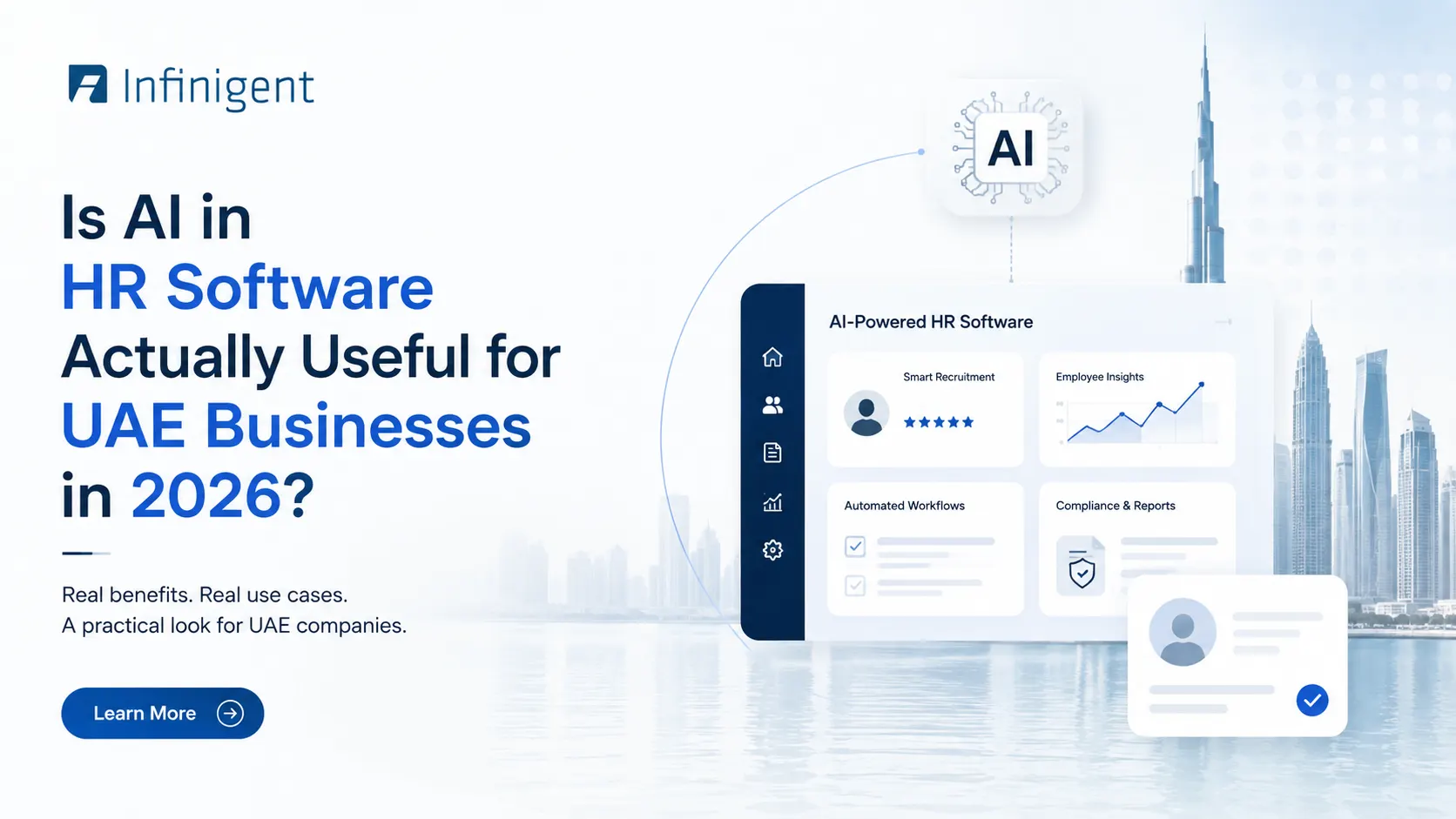
 

AI-powered HR software dashboard with UAE skyline, illustrating AI automation, recruitment, employee insights, and compliance for UAE businesses in 2026.


What AI in HR Software Actually Means

AI in HR software refers to several different technologies, not one single solution. RPA handles repetitive, rules-based tasks such as document processing and government portal updates. Machine learning analyzes data to support recruitment, workforce planning, and retention insights. Generative AI powers chatbots and content creation but can produce inaccurate answers. Understanding these differences helps UAE businesses evaluate AI features realistically and avoid confusing automation with genuine intelligence. 


The term gets used loosely, and vendors benefit when buyers can’t tell the difference between three very different technologies:

  • Robotic Process Automation (RPA): Software robots that execute repetitive, rules-based tasks, filling government portal forms, extracting data from documents, and moving information between systems. RPA doesn’t think it follows a fixed workflow reliably and swiftly.
  • Machine learning / predictive analytics: Models trained on your data to rank candidates, flag attrition risk, or forecast hiring needs. Useful, but only as good as the data feeding it.
  • Generative AI / chatbots: Conversational tools that answer policy questions or draft documents. Fast to demo, but prone to producing confident, wrong answers on compliance-sensitive topics unless tightly grounded in your actual policies.

Most AI HR software pitches blend all three under one glossy label. A buyer’s guide is only useful if it helps you separate them.

Why This Matters More in the UAE Than Almost Anywhere Else

UAE HR decisions carry real financial exposure that generic HR advice from other markets doesn’t capture. A few figures worth knowing as of 2026:

  • Mainland companies with 50 or more employees must reach 10% Emiratization in skilled roles by 31 December 2026, with penalties of AED 9,000 per month, roughly AED 108,000 a year, for every unfilled position.
  • Companies with 20–49 employees in 14 targeted sectors face a lump-sum AED 108,000 contribution for missing their Emirati hiring quota, collected the following January.
  • MOHRE has already penalized over 1,300 establishments for fake Emiratization, using AI-driven monitoring alongside field inspections to detect sham hires; this is not a manual, once-a-year audit anymore.
  • WPS salary transfers, gratuity calculations under Federal Decree-Law No. 33 of 2021, and Emirates ID/visa renewal timelines all carry their own penalty structures if handled incorrectly.

This is the environment an HR/compliance manager or group HR director is actually operating in: a regulator that is itself automating enforcement. That changes the calculus. A generative AI chatbot that summarizes leave policy is a nice-to-have. A system that reliably keeps visa renewals, WPS submissions, and Emirati registration status audit-ready is a compliance safeguard.

Where AI and Automation Genuinely Solve UAE HR Problems

AI HR automation can solve several practical UAE HR challenges. RPA simplifies repetitive visa and document processing, reducing manual errors and onboarding delays. Machine learning can screen large volumes of CVs and identify suitable candidates faster. Automation can also keep track of rules by alerting about Emirates ID expirations, WPS issues, and risks related to Emiratisation quotas. These applications deliver measurable value by improving efficiency, accuracy, and compliance visibility.


Stripped of marketing language, the parts of AI HR automation that hold up under scrutiny in a UAE context tend to fall into three buckets:

  1. Document and visa processing
    Reading, verifying, and re-keying passport, labor card, and Emirates ID data into multiple government portals is exactly the kind of repetitive, rules-based work RPA is built for, and it’s where errors are most costly, since a rejected visa application can delay onboarding by weeks.
  2. Candidate screening at volume
    Parsing hundreds of CVs against a UAE-specific role profile and ranking genuine fits is a task machine learning does faster and more consistently than a recruiter working through a stacked inbox..
  3. Compliance-status visibility
    Flagging an expiring Emirates ID, a WPS mismatch, or a skilled-role headcount that’s drifted below quota before it becomes a fine is pattern-matching against known thresholds, not intelligence in any deep sense, but it’s the single highest-value use of automation for a compliance-accountable HR leader.

Where AI in HR software gets shakier is anything that requires judgment on ambiguous, high-stakes questions, generating a termination letter, interpreting a labor law edge case, or making a final hiring decision. Those still belong with a person.

How This Plays Out in Practice: Infinigent’s Approach

Rather than layering a generic chatbot onto an HR platform and calling it AI-powered, Infinigent’s automation is built around the two areas where it demonstrably reduces UAE-specific risk. Our Digital Visa Management solution uses RPA bots and OCR-based document processing to handle visa initiation, renewal, and cancellation directly against MOHRE, GDRFA, and Emirates ID government portals, the repetitive, high-error-risk work that PRO teams currently do by hand. On the recruitment side, AI-driven resume parsing and candidate matching inside our Cloud HCM platform  speeds up screening without pretending to replace a hiring manager’s judgment.


The distinction matters for a buyer’s guide: this is automation grounded in a specific workflow with a measurable outcome (fewer manual re-keying errors, faster visa turnaround, faster shortlist-to-interview time), not a vague promise that AI improves your HR.


A Practical Checklist for Evaluating AI Claims from Any Vendor

Before signing with any provider marketing AI HR software, ask:

  1. Ask which technology is actually running
    Is it RPA, a trained model, or a generative AI wrapper on top of a search index? The answer changes what it can and can’t be trusted to do unsupervised.
  2. Ask for a specific, named workflow
    AI-powered insights is not a workflow. Automatically flags Emirates ID expiries 60 days out and cross-checks Emirati headcount against your quota.
  3. Ask what happens when it’s wrong
    Does a generative AI feature cite the source policy it drew from, or does it just output text? Unsourced AI answers to labor law questions are a liability, not a feature.
  4. Ask how it handles UAE-specific data
    Government portal integrations, Arabic-language processing, and gratuity/GPSSA calculation logic need to be built for UAE regulations; specifically, a platform retrofitted from a US or European base often isn’t.
  5. Ask for a reference client at your scale
    An AI feature that works cleanly for a 30-person startup may not hold up across a 500-employee, multi-subsidiary group with mixed skilled and unskilled roles.

If a vendor can’t answer these plainly, the “AI” in the pitch is probably branding, not capability.

Conclusion:

AI in HR software isn’t a single feature you either have or don’t , it’s a mix of technologies, and only some of them earn their place in a UAE compliance environment where MOHRE itself is automating enforcement. The useful parts are narrow and specific: RPA that removes manual visa and document work, and matching models that speed up screening. The rest is often marketing dressed up as innovation. If you’re evaluating platforms for your organization, talk to our team  about which parts of your HR and visa workflow are actually worth automating  and which aren’t.

Frequently Asked Questions: 

Is AI HR software actually necessary for UAE businesses in 2026?

Not universally. It’s most valuable where UAE compliance work is repetitive and high-volume visa processing, document verification, and quota tracking and least valuable where it’s being used to justify a price premium without a specific, named workflow behind it.

What is the difference between RPA and AI in HR software?

RPA automates fixed, rules-based tasks like form-filling and data entry between systems. AI, in the machine-learning sense, makes probabilistic judgments from data, such as ranking candidates or predicting attrition. Many vendors market RPA as “AI” because the term sells better, even though the underlying technology doesn’t learn or adapt.

Can AI HR software help with Emiratisation compliance?

Yes, indirectly. AI-driven tools can flag when skilled headcount drifts below your Emiratization target or when an Emirati hire’s WPS and Nafis registration isn’t complete, both common triggers for the AED 108,000 penalty. It won’t make the hiring decision for you, but it can prevent the paperwork gaps that cause compliance failures.

How much does AI-powered HR software cost in the UAE?

Pricing depends on headcount, modules, and deployment model (cloud vs. on-premise) and varies significantly between vendors. Rather than comparing headline prices, request a demo scoped to your actual workflows, visa volume, payroll complexity, and number of subsidiaries since those are what determine real cost and ROI.

Should generative AI chatbots handle UAE labor law questions?

Treat the technology with caution. Generative AI is useful for looking up an employee’s own leave balance or policy document, but it should not be relied on as a source of truth for labor law interpretation unless it’s explicitly grounded in your company’s current, verified policies. An incorrect answer on a compliance question carries real financial risk.

How does MOHRE use AI to monitor Emiratization compliance?

MOHRE uses its digital monitoring system to check WPS salary data, Nafis registration, and the number of skilled roles, using AI tools and field inspections to identify fake Emiratisation. UAE nationals registered on paper without real duties. Over 1,300 establishments This method has already penalized over 1,300 establishments, making it essential for compliance status to be genuinely accurate rather than merely appearing correct on a spreadsheet. penalized this way, so compliance status needs to be genuinely accurate, not just look correct on a spreadsheet.

Do free zone companies in the UAE need AI HR software for Emiratization compliance?

Most free zone companies are currently exempt from MOHRE’s mandatory Emiratisation quotas, since the rules apply specifically to UAE mainland employers. That said, DIFC and ADGM run their own employment frameworks, some free zones have introduced voluntary Emiratization initiatives, and government policy has been steadily widening scope  so free zone HR teams shouldn’t assume the exemption is permanent when evaluating compliance-focused automation.

Prev PostRecruitment Software in the UAE: Why Emiratisation and Visa Compliance Can’t Be an ATS Afterthought

About Jotheswaran Munikumar

Jotheswaran Munikumar is the Digital Transformation Lead – HCM, Digital Visa & Microsoft Azure at Infinigent Software Solutions, with 8+ years of experience delivering enterprise Cloud HCM and SaaS implementations across the US, EMEA, and APAC. He leads the delivery of Infinigent's Cloud HCM and Digital Visa Management solutions, covering AI-powered, end-to-end HR digitalization from hiring and onboarding to payroll and performance management along with RPA-driven automation of UAE government visa processes (ICP, GDRFA, MOHRE and Freezone). He writes about HR technology, digital transformation, and intelligent automation.

We provide sustainable value added suite of best applications, custom software development and smart business process automation solutions.

Our Products

  • Cloud HCM
  • Digital Visa Management
  • Employee Performance Management
  • Evaluation and Survey
  • Incentive Management
  • Recruitment Management

Recent Posts

  • Is AI in HR Software Actually Useful for

    Aug 21, 2026

  • Recruitment Software in the UAE: Why Emi

    Aug 21, 2026

  • 7 Signs It’s Time to Switch Your H

    Jul 21, 2026

Useful Links

  • Home
  • Contact Us
  • Software Services
  • FAQ
  • About Us
  • Blog
  • Privacy
  • IT Consulting Services
info@infinigent.com Drop Us a Line
+971 4 556 1999 / +971 508688043 Contact Us today!
Business Center, Dubai World Central, Dubai, UAE.
@2026 Infinigent, All rights reserved.
Manage Cookie Consent
To provide the best experiences, we use technologies like cookies to store and/or access device information. Consenting to these technologies will allow us to process data such as browsing behavior or unique IDs on this site. Not consenting or withdrawing consent, may adversely affect certain features and functions.
Functional Always active
The technical storage or access is strictly necessary for the legitimate purpose of enabling the use of a specific service explicitly requested by the subscriber or user, or for the sole purpose of carrying out the transmission of a communication over an electronic communications network.
Preferences
The technical storage or access is necessary for the legitimate purpose of storing preferences that are not requested by the subscriber or user.
Statistics
The technical storage or access that is used exclusively for statistical purposes. The technical storage or access that is used exclusively for anonymous statistical purposes. Without a subpoena, voluntary compliance on the part of your Internet Service Provider, or additional records from a third party, information stored or retrieved for this purpose alone cannot usually be used to identify you.
Marketing
The technical storage or access is required to create user profiles to send advertising, or to track the user on a website or across several websites for similar marketing purposes.
Manage options Manage services Manage vendors Read more about these purposes
View preferences
{title} {title} {title}