Our top products

  • Cloud HCM
  • Digital Visa Management
  • Employee Performance Management
  • Evaluation and Survey
  • Incentive Management
  • Recruitment Management
  • +971 4 556 1999
  • info@infinigent.com
  • Sat – Thu 8:00am – 6:00pm
Infinigent Infinigent
  • Home
  • Products
    • HCM & Payroll
      • Overview
      • Human Resource
      • Time & Attendance
      • Payroll
      • Employee Self-Service
      • Performance Management
      • Recruitment
    • Digital & Other Solutions
      • Digital Visa Management
      • Project Resource Management
      • Customer & Project Management
      • Evaluation and Survey
      • Incentive Management
  • Services
    • Software Services
    • IT Consulting Services
  • Company
    • About Us
    • FAQ
    • Privacy Policy
    • Terms of Use
  • Blog
  • Contact Us
Recruitment Software in the UAE: Why Emiratisation and Visa Compliance Can't Be an ATS Afterthought

Recruitment Software in the UAE: Why Emiratisation and Visa Compliance Can’t Be an ATS Afterthought

Table of Contents

  • What Recruitment Software UAE Compliance Actually Means
  • Why It Matters: The Real Stakes for HR and PRO Teams
  • How Infinigent Fits: Closing the Gap Between Hiring and Compliance
  • A Practical Compliance Checklist for Every UAE Hire
  • Conclusion:
  • Frequently Asked Questions: 

Recruitment software in the UAE must go beyond traditional ATS functions because hiring decisions directly affect Emiratisation compliance and visa processing. Companies need systems that track nationality quotas, skilled-role requirements, work permits, entry permits, medical tests, Emirates ID, and visa deadlines in one connected workflow. By integrating recruitment with visa and compliance management, HR and PRO teams can reduce data mismatches, avoid missed deadlines, maintain accurate Emiratisation records, and minimize the risk of regulatory penalties.

Most HR teams buy recruitment software to fix a hiring problem: slow pipelines, scattered CVs, missed follow-ups. But in the UAE, every hiring decision is also a compliance event. A skilled role left unfilled by an Emirati national can cost a mainland company AED 9,000 a month. A new hire’s employment visa runs on a strict, multi-agency clock that starts the moment an offer is signed. If your recruitment software UAE compliance strategy treats these as HR’s problem to solve after the CV is approved, you’re already behind.
 

Recruitment Software in the UAE: Why Emiratisation and Visa Compliance Can't Be an ATS Afterthought


What Recruitment Software UAE Compliance Actually Means

Recruitment software UAE compliance means connecting the hiring process with Emiratization and visa requirements, rather than treating compliance as a separate HR task. A standard ATS can manage applications, interviews, and offers, but UAE employers also need visibility into Emirati workforce ratios, qualifying roles, work permits, entry permits, medical tests, Emirates ID, and visa deadlines. An integrated system helps HR teams monitor these requirements from requisition to onboarding, reducing compliance gaps, delays, and administrative risks.


An applicant tracking system (ATS) manages the hiring funnel, job postings, resume parsing, interview scheduling, and offer letters. That’s necessary, but in the UAE it’s only half the job. Every hire also triggers two parallel regulatory tracks that a generic ATS was never built to see.


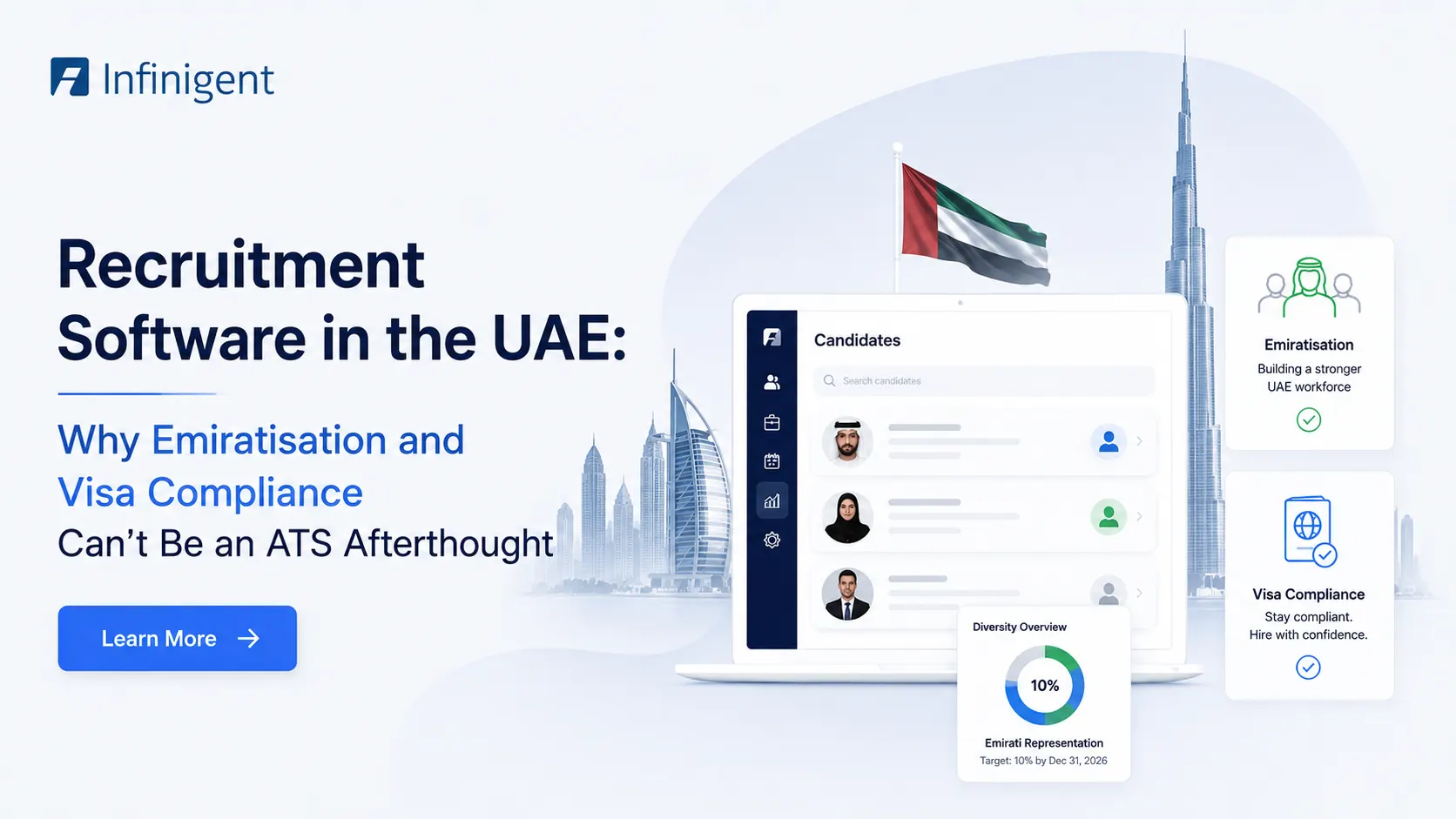
The first is Emiratisation. Mainland private-sector companies with 50 or more skilled employees must reach 10% Emirati representation in skilled roles by 31 December 2026, the final step of a target that has climbed two percentage points a year since 2023. A separate rule captures companies with 20–49 employees across 14 targeted sectors. Every open-skilled requisition either counts toward that ratio or works against it from the moment it’s created, not from the moment someone signs.


The second requirement pertains to UAE employment visa regulations. A new hire cannot legally start work until MOHRE issues a work permit, which then unlocks the entry permit, medical test, status change, Emirates ID biometrics, and visa stamping a sequence that commonly runs 2-4 weeks and can stretch past 30 days if any document doesn’t match. The entry permit itself is only valid for 60 days, and every residency step has to close inside that window. An ATS that only tracks “hired” or “not hired” has no visibility into either of these clocks.

Why It Matters: The Real Stakes for HR and PRO Teams

For an HR or compliance manager, the Emiratisation math is unforgiving. The 2026 penalty is AED 9,000 per month for every unfilled Emirati position, AED 108,000 a year, per role. A company short by five positions is looking at over half a million dirhams annually. And the position only counts once the Emirati hire is registered on both WPS and the pension/GPSSA system, which must happen within one month of the work permit being issued. If you miss that administrative step, the hire will not count against your quota, regardless of the role’s legitimacy. MOHRE also runs AI-driven monitoring for “fake Emiratisation” hires listed on payroll without real duties with fines up to AED 100,000 per fraudulent case and criminal exposure attached.


For a PRO or government-relations coordinator, the risk sits in the visa chain. Data mismatches, like a passport number or a job title that doesn’t match the MOHRE-filed offer letter word for word, are the most common cause of delay. A stalled work permit doesn’t just push back one start date; it can freeze the company’s ability to process other pending permits at the same time, compounding the Emiratisation exposure above it. Neither risk is visible from a standard hiring dashboard. Both are visible the moment recruitment data is connected to compliance data.

How Infinigent Fits: Closing the Gap Between Hiring and Compliance

The fix isn’t a better CV filter; it’s a recruitment process that’s structurally connected to compliance from the requisition stage onward. Our recruitment management system gives HR teams a real hiring pipeline with job postings, candidate scoring, interview workflows, and structured offer management while flagging nationality-quota impact against your live Emiratisation ratio as roles are opened and filled, not months later at an audit.


Where most competitor ATS platforms in the region stop to track nationality in the pipeline or upload a visa document, that’s exactly where the real risk starts. Once an offer is accepted, our Digital Visa Management solution takes over the work permit, entry permit, medical, Emirates ID, and visa stamping sequence with RPA that talks directly to government service portals instead of a PRO team manually re-keying candidate data from the ATS into a separate visa tracker and hoping nothing differs between the two. Hiring-to-working becomes one connected workflow instead of a handoff between disconnected systems, which is where data-mismatch delays and missed pension-registration deadlines usually originate.

A Practical Compliance Checklist for Every UAE Hire

Before a requisition opens, and before an offer goes out, run each hire through this:

  1. Classify the role correctly and confirm the position sits within MOHRE’s qualified occupational levels 1–5, since your Emiratization ratio is calculated only against qualified roles.
  2. Check the current quota position to know whether this hire moves you toward or away from your 10% target before you post the job.
  3. Match the offer letter to the MOHRE filing word-for-word; job title, salary, and terms must be identical at every downstream visa stage.
  4. Track the 60-day entry permit clock from work permit issuance; every residency step (medical, biometrics, and visa stamping) has to close inside that window.
  5. Register Emirati hires on WPS and GPSSA within 30 days of work permit issuance; this is the step that actually makes the hire count toward the quota.
  6. Confirm the minimum wage floor, New and renewed Emirati work permits from January 2026 carry a AED 6,000/month minimum.
  7. Document everything,MOHRE’s AI-driven inspections check payroll, attendance, and registration data directly, not self-reported figures.

Conclusion:

Recruitment software UAE compliance isn’t a feature you bolt onto an ATS after the fact; it’s a design decision that starts at the requisition stage and carries through to the moment a new hire is legally working and registered. Every open skilled role affects your Emiratisation ratio; every accepted offer starts a visa clock with real deadlines and real penalties for missing them. Infinigent connects recruitment, HR, and digital visa management into one platform so compliance risk is visible before it becomes a fine not discovered during an MOHRE audit. Contact our team to see how integrated recruitment and visa-linked onboarding works for your workforce.

Frequently Asked Questions: 

1. What is the Emiratisation quota for private companies in the UAE in 2026?

Mainland private-sector companies with 50 or more skilled employees must reach 10% Emirati representation in skilled roles by 31 December 2026. Companies with 20–49 employees in 14 targeted sectors face a separate annual hiring obligation under a related MOHRE framework.

2. How much is the Emiratisation fine for an unfilled position?

For companies with 50 or more employees, the 2026 penalty is AED 9,000 per month for each unfilled skilled position required under quota  equivalent to AED 108,000 per year, per role. The rate has risen by AED 1,000 annually since 2023.

3. How long does the UAE employment visa process take after a job offer?

The full sequence  work permit, entry permit, medical test, status change, Emirates ID biometrics, and visa stamping  typically takes 2–4 weeks, though it can run 8–32 working days depending on document accuracy and appointment availability. The entry permit itself is valid for only 60 days.

4. Does a recruitment ATS alone handle UAE visa and Emiratisation compliance?

Not on its own. A standard ATS manages the hiring funnel  postings, screening, interviews, offers  but visa processing and Emiratisation quota tracking require integration with government-linked visa management and payroll/HRMS systems so hire data flows through without manual re-entry.

5. Why does an Emirati hire not always count toward the Emiratisation quota?

A hire only counts once they’re registered on the Wage Protection System and contributing to the pension/GPSSA system, which must happen within one month of the work permit being issued. Employers who skip or delay this registration step find the hire doesn’t reduce their quota shortfall, even though the person is genuinely on payroll.

6. Are free zone companies exempt from UAE Emiratisation quotas?

Most free zone companies are currently exempt from mandatory Emiratisation quotas, since the framework is administered by MOHRE and applies to mainland-registered entities. This exemption is policy-based rather than written into statute, and several free zones are progressively aligning their practices with mainland standards, so free zone employers shouldn’t assume it holds indefinitely.

7. What happens if an Emirati employee resigns and my company falls below quota?

MOHRE grants a two-month grace period from the date the resignation is recorded before any financial contribution applies, giving the employer time to source and onboard a replacement. If the position is still unfilled once that window closes, the AED 9,000-per-month penalty begins accruing from the original departure date, so recruitment needs to start immediately rather than after the grace period ends.

Prev Post7 Signs It’s Time to Switch Your HR Software For Your Company in UAE
Next PostIs AI in HR Software Actually Useful for UAE Businesses in 2026?

We provide sustainable value added suite of best applications, custom software development and smart business process automation solutions.

Our Products

  • Cloud HCM
  • Digital Visa Management
  • Employee Performance Management
  • Evaluation and Survey
  • Incentive Management
  • Recruitment Management

Recent Posts

  • Is AI in HR Software Actually Useful for

    Aug 21, 2026

  • Recruitment Software in the UAE: Why Emi

    Aug 21, 2026

  • 7 Signs It’s Time to Switch Your H

    Jul 21, 2026

Useful Links

  • Home
  • Contact Us
  • Software Services
  • FAQ
  • About Us
  • Blog
  • Privacy
  • IT Consulting Services
info@infinigent.com Drop Us a Line
+971 4 556 1999 / +971 508688043 Contact Us today!
Business Center, Dubai World Central, Dubai, UAE.
@2026 Infinigent, All rights reserved.
Manage Cookie Consent
To provide the best experiences, we use technologies like cookies to store and/or access device information. Consenting to these technologies will allow us to process data such as browsing behavior or unique IDs on this site. Not consenting or withdrawing consent, may adversely affect certain features and functions.
Functional Always active
The technical storage or access is strictly necessary for the legitimate purpose of enabling the use of a specific service explicitly requested by the subscriber or user, or for the sole purpose of carrying out the transmission of a communication over an electronic communications network.
Preferences
The technical storage or access is necessary for the legitimate purpose of storing preferences that are not requested by the subscriber or user.
Statistics
The technical storage or access that is used exclusively for statistical purposes. The technical storage or access that is used exclusively for anonymous statistical purposes. Without a subpoena, voluntary compliance on the part of your Internet Service Provider, or additional records from a third party, information stored or retrieved for this purpose alone cannot usually be used to identify you.
Marketing
The technical storage or access is required to create user profiles to send advertising, or to track the user on a website or across several websites for similar marketing purposes.
Manage options Manage services Manage vendors Read more about these purposes
View preferences
{title} {title} {title}